• Project • People • Expeditions • Products • Images • Bibliography • Collections •
Discovery and description of the megadiverse flora of Papua New Guinea
Papua New Guinea (PNG) is considered one of the most species rich areas in the world, hostsing about 6% of the world’s flora, and high levels of species endemism. However, there remains considerable speculation as to the size of the vascular flora, with estimates currently ranging from 11,000 to 25,000 species. The general consensus among authorities is that no plant family in PNG has been adequately inventoried nor studied. Such uncertainty in the knowledge of the taxonomy and extent of botanical diversity of the region hampers the prediction of the effects of anthropogenic actions, such as forestry and climate change, and development of conservation plans. Many more species may be threatened with extinction than the 1% currently listed by the IUCN, particularly as forest is currently being removed or degraded at the rate of 1.4% per year.
Despite species richness in many plant groups, New Guinea remains one of the most poorly-collected regions of Melanesia for the vascular flora. Average collection density (number of specimens per unit area) for PNG remains low at ~26 specimens per 100 km2, but with a maximum at ~770 per 100 km2. The minimum number for adequate floristic inventory is considered to be 50 collections per 100 km2 (red and green grid squares in the image above). Only 15% of the country meets or exceeds this minimum based on our analysis of the number of collections per quarter-degree grid cell. The areas with highest collecting density tend to be in road-accessible areas, along major rivers or the seacoast, subalpine and alpine areas on several massifs, and regions around large communities (e.g., Port Moresby, Lae).
Goals
The goals of this NSF-funded project are to:
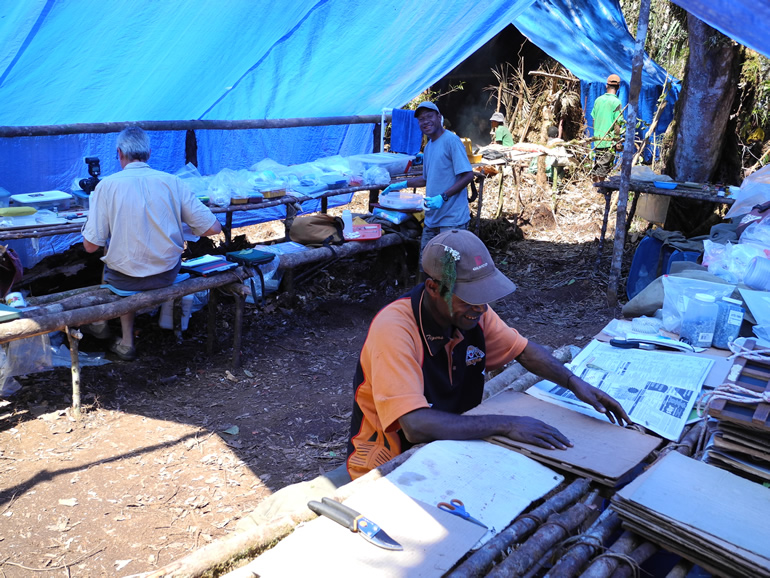
- Undertake botanical surveys in nine previously under-collected, species-rich areas in Papua New Guinea (PNG) to identify taxa new to science and range extensions of both poorly known and common species, obtain representative herbarium specimens and color images of vascular plants in each area, and obtain tissues for future genetic analysis.
- Augment and digitize botanical collections in PNG, and digitize and curate the Herbarium Pacificum (BISH) Papua New Guinea collections. Of the estimated 25,000 sheets from PNG in BISH, only 36% are currently databased and few have associated locality coordinates.
- Organize an international effort to develop a comprehensive checklist of the flora of PNG and add to the database of georeferenced collection data of PNG vascular plant specimens in national and international herbaria. Using spatial analysis tools of ArcGIS software, gain a comprehensive understanding of the richness and distribution of vascular plant species in PNG in relation to geology and climate. This will allow us to focus future botanical survey in under-collected and species-rich areas to maximize collection efficiency. Maps of species distribution, richness, and endemism will be used to suggest conservation measures in the light of the rapid ongoing forest degradation in PNG and climate change.
- Use distributional data for vascular plant species, combined with faunal distribution data, to improve understanding of centers of regional endemism within PNG.
- Train graduate and undergraduate students and parataxonomists in the disciplines of collections care, botany, systematics, field biology, and conservation biology.
- Make information on floral distributions and community compositions available to the PNG government and interested NGO’s for use in biodiversity planning activities. Assist in the establishment of a PNG Biological Survey as part of the basic in-country infrastructure and capacity needed for the protection of PNG’s biological resources.
The Papuan Region
New Guinea and adjacent islands are beset with confusing terminology. We refer to New Guinea as the entire island, including small, biogeographically associated satellite islands. The western half of New Guinea is politically part of Indonesia and is currently divided into Papua and West Irian Jaya provinces but was previously known as Irian Jaya and, prior to that, was Dutch New Guinea. The eastern half of New Guinea is occupied by the sovereign nation of Papua New Guinea, which also includes within its eastern boundaries the Admiralty and Bismarck Archipelagos and Bougainville and Buka islands. These latter two islands, together with a string of high islands and atolls to the SE, comprise the Solomon Islands, which, except for Bougainville and Buka, are politically part of the sovereign nation of the Solomon Islands. The entire area - New Guinea, the Admiralty and Bismarck Archipelagos and the Solomon Islands - is generally called the Papuan region.
The island of New Guinea is often likened to the shape of a bird, with the head consisting of the Vogelkop Peninsula in the far Northwest and the Southeastern Peninsula comprising the tail. A mountain axis runs the length of the island from the northwest to the southeast and divides the island into northern and southern versants. To the north of this Central Dividing Range lies a series of smaller ranges referred to as the northern coastal ranges. These extend from the Vogelkop Peninsula in West Papua Province, Indonesia, to the Huon Peninsula in Morobe Province, Papua New Guinea.
The geological history of the Papuan region is complex, which makes it of great interest for evolutionary studies. The southern half of New Guinea is the northernmost extension of the Australian Craton. Onto this continental margin two separate offshore island arc systems have been sutured by the collision of the Australian and Pacific plates. Approximately 45-50 million years ago, the Papuan Arc system accreted to the northern margin of the Australian Craton, creating what is now the Central Dividing Range. Within the past 10 million years, a second arc system, the Solomons Arc, has collided with New Guinea with a clockwise rotational motion, creating the series of northern coastal ranges. The offshore Bismarck and Solomon island groups are part of this same colliding arc system and are expected to dock with New Guinea over the course of the next several million years. The Southeastern Peninsula is a composite of geological terranes sutured together over a period of several million years and this landmass connected with the main mass of New Guinea approximately 30 million years ago.
This geological history has produced the worlds largest (~890,000 km²) and highest (5,030 m) tropical island, which includes permanent glaciers within 20 km of typical wet tropical lowlands. Its combination of high equatorial temperatures, a variety of rainfall regimes, and rich volcanic soils has resulted in a diverse array of vegetation types dominated by rainforest, but also including mesic forest, seasonal dry forest, savannah, alpine grassland, and tundra. This high habitat (β) diversity and geological amalgamation of separate terranes and island-arc systems has promoted the evolution of an enormous, largely endemic, biota in which closely related species replace one another along altitudinal gradients, as well as across island arc systems, mountain ranges, and adjacent peaks and uplands.
Areas to be surveyed
We are proposing to explore 9 of the 15 proposed expedition sites by Bishop Museum's Papuan herpetofauna project. These localities are scattered around Papua New Guinea but concentrated in the Southeastern Peninsula and adjacent islands because of their especially poorly collected history.
Eleven of the 15 proposed expeditions sites are also of high priority (*) for botanical surveys:
*1. Finisterre Range, Madang Province (Expedition 1 - Sept/Oct 2010)
*2. Adelbert Range, Madang Province
*3. Whiteman Range, West New Britain Province (Proposed Expedition 2 - Feb 2011)
*4. Sibium Mts., Oro (Northern) Province
*5. Mt. Victory, Oro (Northern) Province
*6. Mt. Strong, Central/Morobe Province
7. Mt. Victoria, Central Province
8. Mt. Suckling, Oro (Northern) Province
9. Aseki, Gulf Province
*10. Mt. Eruki, Gulf Province
*11. West Range, Sandaun (West Sepik) Province
*12. Central Range, Sandaun (West Sepik) Province
*13. Mueller Range, Western Province
*14. Blucher Range, Western Province
15. Mt. Bosavi, Southern Highlands Province
This project is funded in part by the National Science Foundation (DEB-0950207).
The Bishop Museum is an active supporter of the United States Virtual Herbarium (USVH) project.